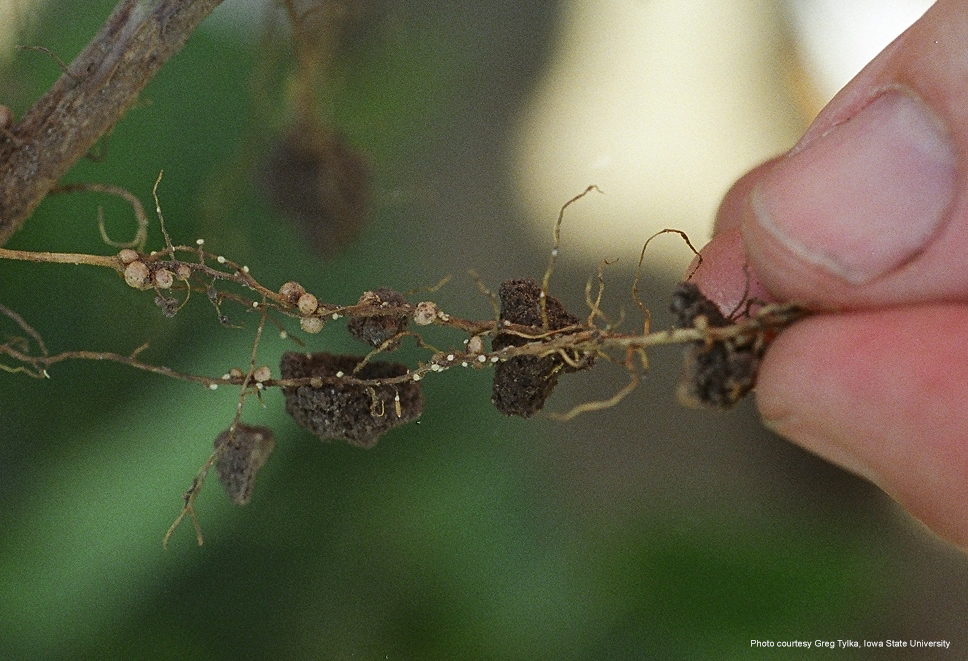
Every U.S. soybean production area has documented cyst nematode populations. Recommending a seed treatment plan that includes a nematicide will help ensure your growers aren’t losing money to these silent yield robbers.
“Soybean cyst nematode (SCN) is the number one pathogen of soybeans,” says Dair McDuffee, product development manager for seed treatments at Valent U.S.A. “But the one thing it’s not number one in is visibility. It is an extremely hard pest to understand and see the effects of, which can be very challenging when trying to explain to your customers the impact these nematodes have on their crop.”
Often, underground nematode feeding appears as discolored plants or stunted areas of a field, mimicking water issues or nutrient deficiencies.
Identify and plan
Post-harvest soil testing for nematodes is key to understanding what nematode species are infesting growers’ fields and what pressure level exists.
The SCN Coalition’s SCN Profit Checker is an online tool that further assists growers in calculating potential yield loss caused by nematode feeding.
As an example, McDuffee used the free online tool to calculate potential nematode-related yield loss for an Indiana soybean field with a low to medium SCN egg count and 20% sandy soil. With inputted factors historically conservative for the area, the calculator predicted a 6.8% yield loss.
“With other aspects of agriculture, if we understood that there was 7% yield difference we could affect, we would move heaven and earth trying to capture that,” McDuffee says. “Everyone is working on the margins right now, trying to get maximum returns.”
Multifactor control
While many currently available soybean varieties offer genetically built-in nematode resistance, that protection may be waning.
“A source of genetic resistance called PI-887/888 was a victim of its own success. It worked extremely well when it came out and had almost no negative aspects as it was incorporated into germplasm,” McDuffee says. “Over time, the nematodes adapted and learned to reproduce on soybeans with that source of resistance.”
Recommended actions to effectively control nematode populations include:
- Clean machinery before moving it from field to field, if possible. Otherwise, choose the field with the highest nematode populations to work last before moving to the shop for cleanings.
- Plant varieties with newer nematode resistance packages, such as Peking.
- Routinely rotate to non-host crops.
- Include a nematicide in seed treatment protocols.
Aveo® EZ Nematicide is a seed protectant that helps suppress nematodes, including SCN, while ensuring soil microbes’ health.
“Aveo is a low-use-rate seed treatment that provides the protection growers need, and it doesn’t impede you from treating seed with other products, such as inoculants, micronutrients,” McDuffee says.
Aveo can be used as an every-acre product or prescriptively for fields experiencing high nematode pressure. The seed treatment is also compatible with all soybean varieties and trait packages. Aveo also has activity on multiple nematode species, including SCN, root-knot nematode, and reniform nematode.
“And specifically with root-knot nematode, we see Aveo’s metabolites paralyze the targeted pest. When those nematodes are paralyzed, they’re no longer able to feed on roots,” McDuffee says.
For more information about Aveo, visit Valent.com or contact your local Valent representative.