Skip the sunscreen, get burned. Skip soybean cyst nematode (SCN) control, lose yield.
It’s harder to reduce high SCN population densities than to keep low populations low. That’s why, in July and August, Valent U.S.A. and The SCN Coalition are partnering on the “Start Low, Stay Low” campaign to promote proactive SCN management and help protect soybean yield.
Proactive SCN management
Once SCN is in a field, it cannot be eradicated. Completing as many as six generations in a single growing season, even low SCN population densities can become a larger yield theft if left unmanaged.
With no in-season rescue treatment available and SCN populations increasingly capable of reproducing on PI 88788 — the most widely used source of resistance in commercial soybean varieties — farmers need to take a closer look at their management approach to protect yield and reduce nematode population densities.
“Effective SCN management can help keep populations low and protect soybean yield. We want farmers to think about the steps they are taking to slow SCN population growth before it becomes a yield-limiting problem,” says Horacio Lopez-Nicora, soybean pathologist and nematologist at The Ohio State University. “From rotating sources of SCN resistance and including a non-host in the rotation to considering nematode‑protectant seed treatments, farmers can develop an integrated management plan tailored to their operation.”
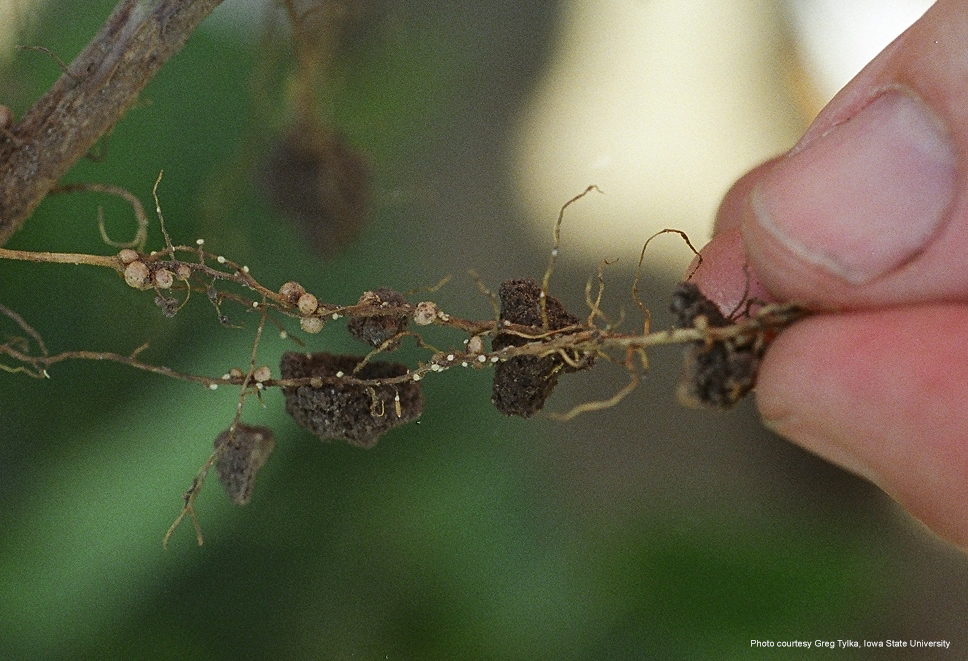
When scouting for SCN during the growing season, gently dig roots and remove excess soil. White SCN females are much smaller than nitrogen-fixing nodules.
Multifactor control for multiple nematodes
By protecting soybean roots from nematode feeding, nematode-protectant seed treatments are one of many tools farmers can consider, especially when several nematode species are present. In addition to potentially limiting nematode reproduction, these treatments can improve root health and provide some protection against other soilborne pathogens.
While SCN is the No. 1 yield-grabbing pathogen of the soybean crop in North America, root-knot nematode (RKN) is the most prominent threat in the South. “With several rising soybean threats like RKN, farmers need to take an active management approach,” says Dair McDuffee, product development manager for seed treatments for Valent U.S.A. “We want to show farmers how a few proactive steps can help them stay ahead of these threats and protect their bottom line.”
McDuffee says nematode-protectant seed treatments like Aveo® EZ Nematicide help provide another mode of action that pairs well with SCN-resistant varieties and is labeled for multiple nematode species.
Expanded nematode management resources
To support that proactive approach, The SCN Coalition collaborated with university and extension experts to extend their educational outreach and created the Soybean Nematode Management Guides.
The guides incorporate the latest research and management tactics to help farmers protect and reclaim yield from SCN, RKN, root lesion and reniform nematode.
Using the guides alongside the SCN Profit Checker calculator — a tool that defines SCN’s toll on individual fields — farmers can better assess their risks and determine which active management strategies best fit their fields.
“We want farmers to understand the potential threat of plant-parasitic nematodes and make data-driven decisions for next year using those results,” says Dylan Mangel, plant pathologist at the University of Nebraska. “With a proactive management plan and support from local agronomic experts, farmers can better manage plant-parasitic nematode population densities and meet their soybean yield goals.”
As farmers spend time in their fields this summer assessing crops, it’s an opportunity to scout for nematode risks and think about management decisions that can help protect yield potential in future seasons. Follow @thescncoalition on Facebook, X and LinkedIn for more “Start Low, Stay Low” tips.